How interest rate moves drive bond returns
As markets and financial media clamour over major central banks’ interest rate decisions, we explore the impact of rate moves on bond returns.

As markets and financial media clamour over major central banks’ interest rate decisions, we explore the impact of rate moves on bond returns.
It’s been a turbulent few years for bond investors. Rapid rate hikes by central banks in 2022 triggered unprecedented declines in bond markets, investors suffered significant losses that year, with many questioning if bonds could still offer the same portfolio stabilising benefits against equity volatility that had been a hallmark of the asset class.
It is in this type of environment that multi‑asset products, which tend to be diversified portfolios combining equities and bonds, become increasingly relevant. Multi-asset portfolios offer a more balanced and resilient investment approach, especially during periods when traditional asset class relationships come under strain, as they offer a smoother way to navigate testing market landscapes.
Since then, bonds have been slowly making a comeback. With today’s higher interest rates providing attractive starting yields and policymakers in rate-cutting mode, the long-term return outlook for bonds has improved compared with recent years. For example, the Vanguard Capital Markets Model (VCMM) simulations indicate an expected return of 3.4%1 for euro-area government bonds over the next ten years (based on model assumptions)2.
Higher starting bond yields mean newly issued bonds offer higher income than bonds issued during low interest-rate periods. This marks an important shift in the contribution of income from bonds to total portfolio return. For multi‑asset investors, this strengthened income profile further enhances the role bonds can play in balancing equity risk.
Bond volatility is primarily a function of duration risk3 (a bond’s sensitivity to a change in interest rates) and increases as duration and maturity rise, all else being equal. For example, bonds with longer durations (measured in years) are more sensitive to rising interest rates because the present value of their future income payments are worth less in a higher interest-rate environment. The opposite is true when interest rates decline - falling policy rates typically cause long-term bond prices to rise.
The rapid rise in interest rates in 2022 caused heightened bond market volatility. This repricing was based on the return an investor would receive if they held the bonds to maturity (yield-to-maturity). When rates are rising, existing bond prices tend to fall to adjust for the change in yield that investors would receive on newer bonds with higher coupons. The opposite is true when rates fall; new bonds offering lower coupons push up the prices of older bonds with higher coupon rates.
Ultimately, bond price volatility comes down to interest rate movements and, more importantly, the market’s expectations of future interest rate changes.
While the relationship between interest rates and bond prices might sound straightforward, bond markets rarely move exactly in line with actual changes in interest rates.
Instead, expectations about future interest rate changes often have an even bigger impact on bond prices than the actual movements in rates. This is because when policy rates are expected to rise or fall, some investors will adjust their bond holdings to try and maximise their returns ahead of any actual rate movements, which can push bond prices further away from their fair value. As a result, investors that tactically position their bond holdings can end up suffering greater losses than those who remain invested in bond portfolios that are more fully diversified across the yield curve.
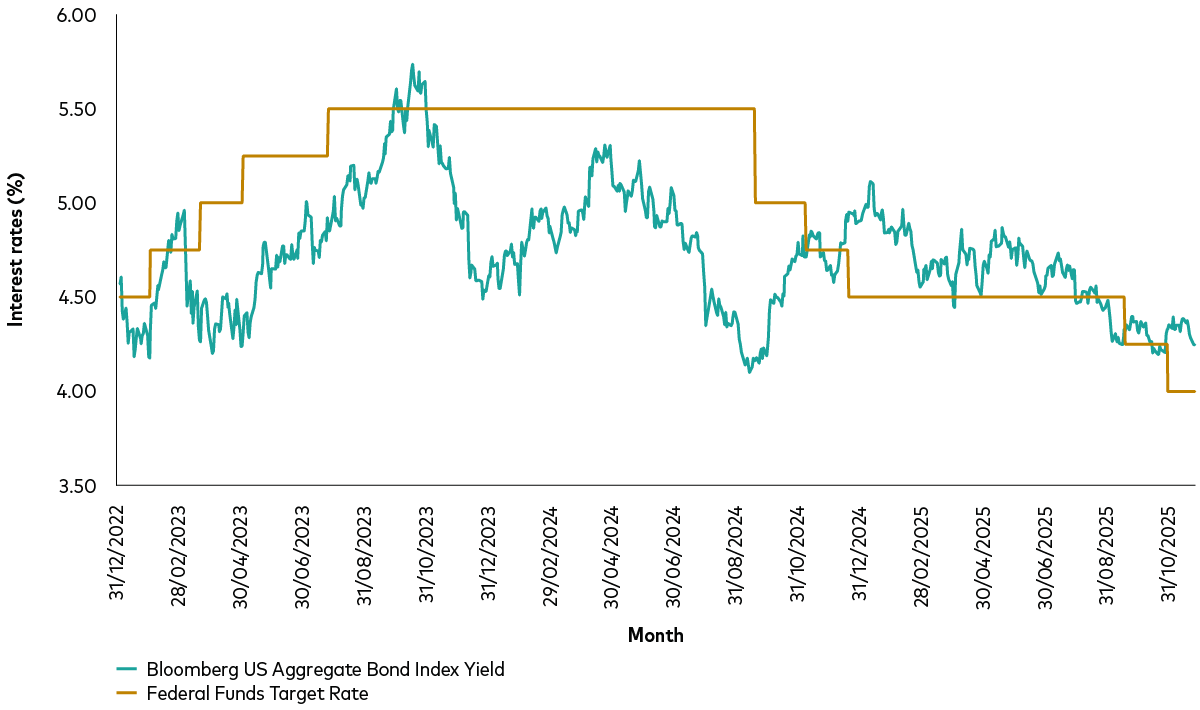
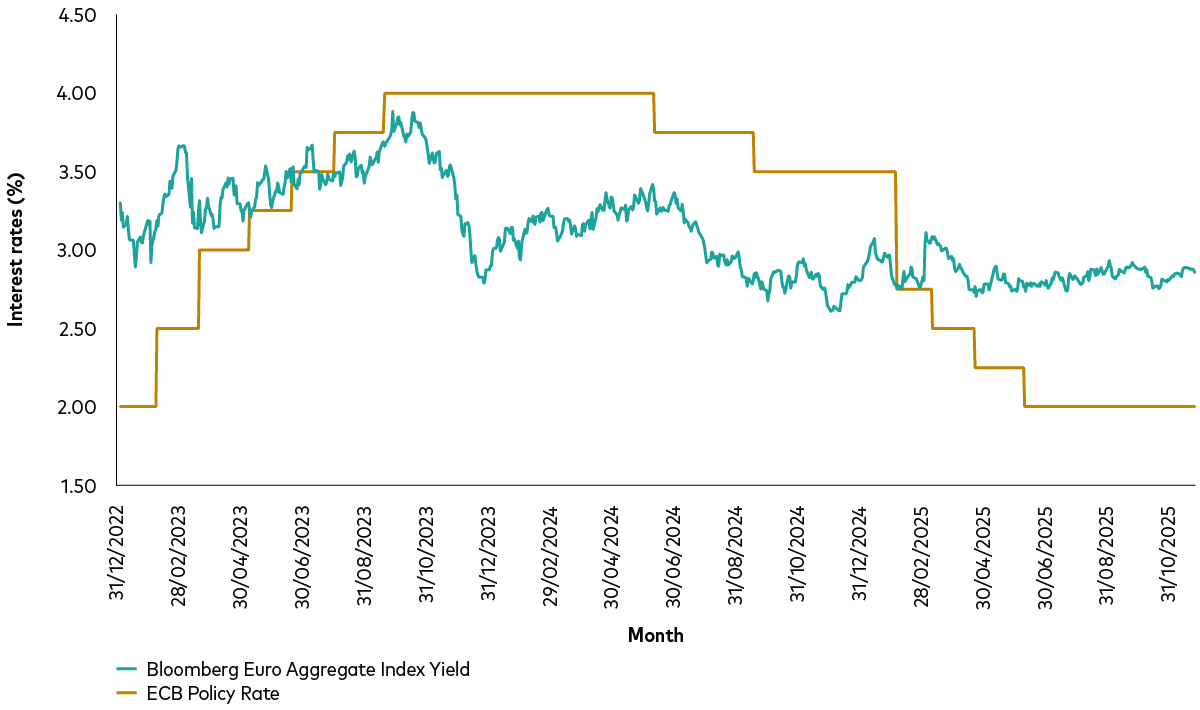
As the US and euro area charts below demonstrates, the short-term correlation between bond yield movements and actual changes in interest rates is relatively low. For example, when policymakers stopped hiking rates around mid-2023, actual interest rates plateaued (the gold line); yet bond yields began to fall significantly (green line). This happened because the market started pricing in future rate cuts - albeit too early and too deeply, as it turned out - before eventually rebounding as investors readjusted their expectations. From late 2024, yields rose once again as investors readjusted their expectations, further supporting the notion that trying to time market movements is extremely difficult. This illustrates how markets overprice interest rate moves, snapping back when the outcomes are different to expectations and driving bond yields in the opposite direction to what was initially priced in.
Low correlation between bond yields and central bank rates
US
Euro area
Past performance is not a reliable indicator of future results.
Source: Vanguard and Bloomberg, as at 25 November 2025.
Notes: For the US: Yield-to-Worst of Bloomberg US Aggregate Bond Index and the US Federal Funds Target Rate (upper bound) from January 2023 to September 2025. The Federal Funds Rate is the target interest rate range set by the Federal Open Market Committee (FOMC). This is the rate at which commercial banks borrow and lend their excess reserves to each other overnight. For the euro area: Yield-to-Worst is for the Bloomberg Euro Aggregate Bond Index and the European Central Bank (ECB) Policy Rate is the deposit facility rate from January 2023 to September 2025 – the deposit facility rate is a key interest rate paid by the ECB on overnight deposits made by banks at their national central banks within the euro area.
Interest rate expectations often lead to some investors trying to market-time their participation. For example, some investors went into cash and short-term bonds to avoid the market volatility and take advantage of higher savings rates on their cash. However, when policymakers started cutting rates in 2024, cash rates quickly followed suit, leaving those investors who were trying to time market movements running the risk of staying in cash for too long and missing out on the potential benefits of a rebound in bond prices.
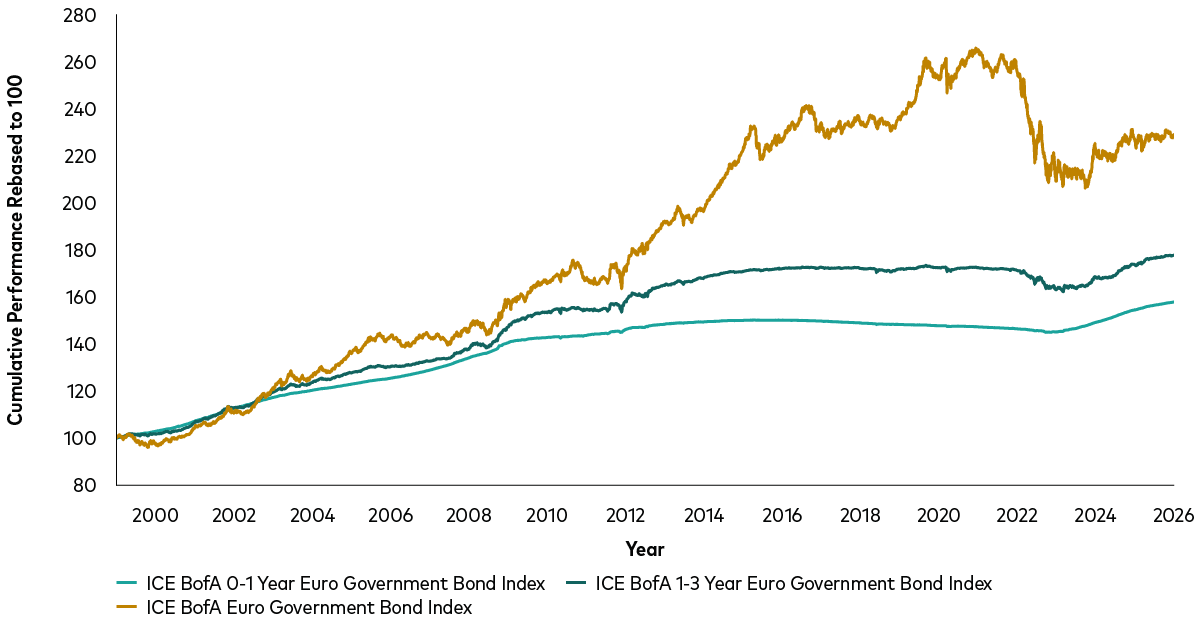
Ultimately, diversified bond holdings have historically offered a counterbalance to equity market volatility, so it’s important for multi-asset investors to think carefully before introducing further risk to their bond exposures by shifting in and out of short- and long-term bonds. Over the period shown in the next chart, a diversified bond exposure, which includes a broad range of durations and maturities, delivered higher cumulative returns than cash and short-term bonds, even with the impact of 2022’s selloff weighing on total returns. (Past performance is not a reliable indicator of future results).
Diversified bonds outperform over the long term (in euro terms)
Past performance is not a reliable indicator of future results.
Source: Vanguard and Bloomberg, as at 30 November 2025.
Notes: Cumulative performance in euros with gross income reinvested of different euro government bond duration segments from 1 January 1999, the launch date of the euro, to 31 December 2025. The money market segment is represented by the ICE BofA 0-1 Year Euro Government Bond Index, the short-duration segment is represented by the ICE BofA 1-3 Year Euro Government Index and the diversified euro bond exposure is represented the ICE BofA Euro Government Bond Index. Source: Bloomberg. Data as of 31 December 2025.
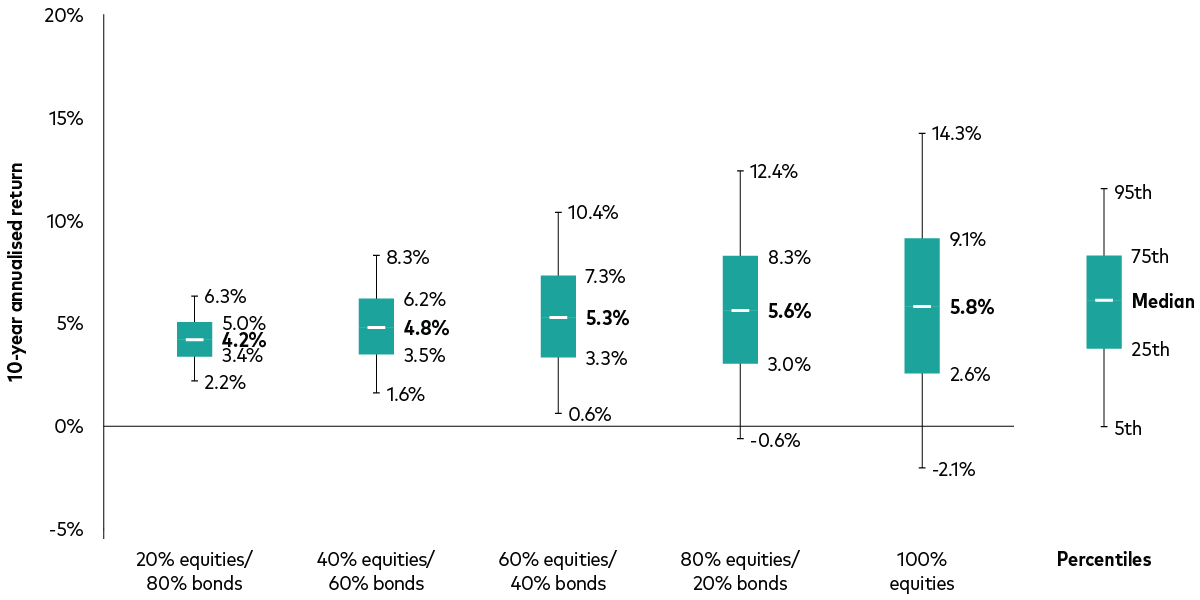
We think today’s higher interest rate environment represents a structural shift that will endure for many years to come. Higher starting yields are good news for bond and multi-asset investors. We remain positive on the long-term return prospects for bond markets which support the favourable return expectations for our lower-risk multi-asset portfolios. The chart below shows our latest 10-year annualised return expectations for euro investors across different equity-bond splits. It shows that the gap between our median return expectations for lower-risk portfolios and higher-risk, higher-equity-allocation portfolios has narrowed. This is being driven by the improved return outlook for bond markets, while high US equity valuations are weighing on the return potential for equities over the next ten years.
Distribution of portfolio return expectations for the next 10 years
Any projections should be regarded as hypothetical in nature and do not reflect or guarantee future results.
Notes: The forecasts correspond to the median of 10,000 Vanguard Capital Market Model (VCMM) simulations for 10-year annualised nominal returns in EUR for multi-asset portfolios highlighted here. Asset-class returns do not consider management fees and expenses, nor do they reflect the effect of taxes. Returns reflect the reinvestment of income and capital gains. Indices are unmanaged; therefore, direct investment is not possible. Equity comprises Euro area equities, Global ex-Euro equities, US equity, Global equity and EM equity. Fixed income comprises Euro area bonds, Global ex-Euro bonds (hedged), Global bonds (hedged), Euro area credit, Global credit (hedged) and EM sovereign bonds (hedged).
Source: Vanguard calculations, as at 31 December 2025.
AI exuberance: Economic upside, stock market downside
Today’s bond market differs significantly from the heightened volatility of 2022, highlighting how quickly market conditions can change. Even with higher starting yields for long-term bonds, timing markets and interest rate cycles remains extremely difficult. That’s why maintaining a disciplined, globally diversified multi-asset approach aligned with a client’s long-term goals and risk preferences continues to be the most reliable way to navigate ever changing and challenging markets.
1 Any projections should be regarded as hypothetical in nature and do not reflect or guarantee future results. VCMM as at 31 December 2025.
2 Forecasts are not guaranteed and are based on assumptions from the VCMM.
3 Duration risk refers to a bond or bond portfolio’s sensitivity to interest rate changes, accounting for characteristics such as yield, coupon rate and maturity. Bond prices move inversely to changes in interest rates, so that if interest rates rise (or fall), bond prices fall (or rise). The longer a bond’s duration, measured in years, the more sensitive its price to interest rate changes. Note that total bond price volatility is also affected by the yield curve, convexity, credit rating and liquidity.


IMPORTANT: The projections or other information generated by the Vanguard Capital Markets Model® regarding the likelihood of various investment outcomes are hypothetical in nature, do not reflect actual investment results, and are not guarantees of future results. VCMM results will vary with each use and over time. The VCMM projections are based on a statistical analysis of historical data. Future returns may behave differently from the historical patterns captured in the VCMM. More important, the VCMM may be underestimating extreme negative scenarios unobserved in the historical period on which the model estimation is based.
The Vanguard Capital Markets Model® is a proprietary financial simulation tool developed and maintained by Vanguard’s primary investment research and advice teams. The model forecasts distributions of future returns for a wide array of broad asset classes. Those asset classes include US and international equity markets, several maturities of the U.S. Treasury and corporate fixed income markets, international fixed income markets, US money markets, commodities, and certain alternative investment strategies. The theoretical and empirical foundation for the Vanguard Capital Markets Model is that the returns of various asset classes reflect the compensation investors require for bearing different types of systematic risk (beta). At the core of the model are estimates of the dynamic statistical relationship between risk factors and asset returns, obtained from statistical analysis based on available monthly financial and economic data from as early as 1960. Using a system of estimated equations, the model then applies a Monte Carlo simulation method to project the estimated interrelationships among risk factors and asset classes as well as uncertainty and randomness over time. The model generates a large set of simulated outcomes for each asset class over several time horizons. Forecasts are obtained by computing measures of central tendency in these simulations. Results produced by the tool will vary with each use and over time.
The primary value of the VCMM is in its application to analysing potential client portfolios. VCMM asset-class forecasts—comprising distributions of expected returns, volatilities, and correlations—are key to the evaluation of potential downside risks, various risk–return trade-offs, and the diversification benefits of various asset classes. Although central tendencies are generated in any return distribution, Vanguard stresses that focusing on the full range of potential outcomes for the assets considered, such as the data presented in this paper, is the most effective way to use VCMM output.
The VCMM seeks to represent the uncertainty in the forecast by generating a wide range of potential outcomes. It is important to recognise that the VCMM does not impose “normality” on the return distributions, but rather is influenced by the so-called fat tails and skewness in the empirical distribution of modelled asset-class returns. Within the range of outcomes, individual experiences can be quite different, underscoring the varied nature of potential future paths. Indeed, this is a key reason why we approach asset-return outlooks in a distributional framework.
Investment risk information
The value of investments, and the income from them, may fall or rise and investors may get back less than they invested.
Simulated past performance is not a reliable indicator of future results.
Any projections should be regarded as hypothetical in nature and do not reflect or guarantee future results.
Important information
For professional investors only (as defined under the MiFID II Directive) investing for their own account (including management companies (fund of funds) and professional clients investing on behalf of their discretionary clients). Not to be distributed to the public.
The information contained herein is not to be regarded as an offer to buy or sell or the solicitation of any offer to buy or sell securities in any jurisdiction where such an offer or solicitation is against the law, or to anyone to whom it is unlawful to make such an offer or solicitation, or if the person making the offer or solicitation is not qualified to do so. The information does not constitute legal, tax, or investment advice. You must not, therefore, rely on it when making any investment decisions.
The information contained herein is for educational purposes only and is not a recommendation or solicitation to buy or sell investments
Issued by Vanguard Group (Ireland) Limited which is regulated in Ireland by the Central Bank of Ireland.
© 2026 Vanguard Group (Ireland) Limited. All rights reserved.