Equity outlook: Moving beyond US growth as AI impact broadens
Following a year of robust returns for global equities, we examine how opportunities could lie outside US growth stocks as 2026 unfolds.

Following a year of robust returns for global equities, we examine how opportunities could lie outside US growth stocks as 2026 unfolds.
Global equities ended 2025 with double-digit returns1. That marked the sixth year since 2019 that global stock market performance exceeded 10% (only interrupted by the pullback in 2022, when high inflation prompted central banks around the world to sharply increase interest rates).
Underneath last year’s strong returns, US equities quickly recovered from the losses around the announced trade tariffs in April. Indeed, US stocks went on to reach all-time highs in the second half of the year – and there are good reasons why we may see a continuation of solid returns in 2026. We expect US economic growth to accelerate to 2.25%2, as investment into AI continues and fiscal policy supports consumers and businesses.
This expectation is in spite of relatively high US equity valuations – but even at current stretched valuations, such momentum would not be unprecedented. In the summer of 1997, for example, the CAPE3 ratio exceeded its 100-year peak, only to rise by a further 36% over the next 30 months before the dot-com bubble eventually started to burst.
Despite the possibility of further rises from growth equities, our conviction is strengthening that the value-oriented parts of the US equity market and non-US developed markets provide attractive prospects. And this view stands whether we look at a scenario in which the productivity benefits of AI lead to an economic boom or a scenario in which current high expectations are not met.
We attach the highest probability to the scenario in which AI changes the way we work and live, and productivity increases significantly. But for this to happen, it would require a broadening of AI benefits to “AI adopters” and companies across all sectors of the economy, leading to higher productivity and profitability.
Our analysis also suggests that the net present value (NPV) of current and projected AI investment is far from certain. In the US alone, investment commitments in AI-related infrastructure going out to 2027 well exceed $2 trillion; however, we think it’s likely that a significant portion of this amount have a negative NPV. High initial and ongoing maintenance expenditures could erode the profit margins of companies with more limited pricing power, making it difficult to deliver the earnings growth that markets currently expect.
Positive NPV of AI spending only for firms with strong competitive moats and cheap capital
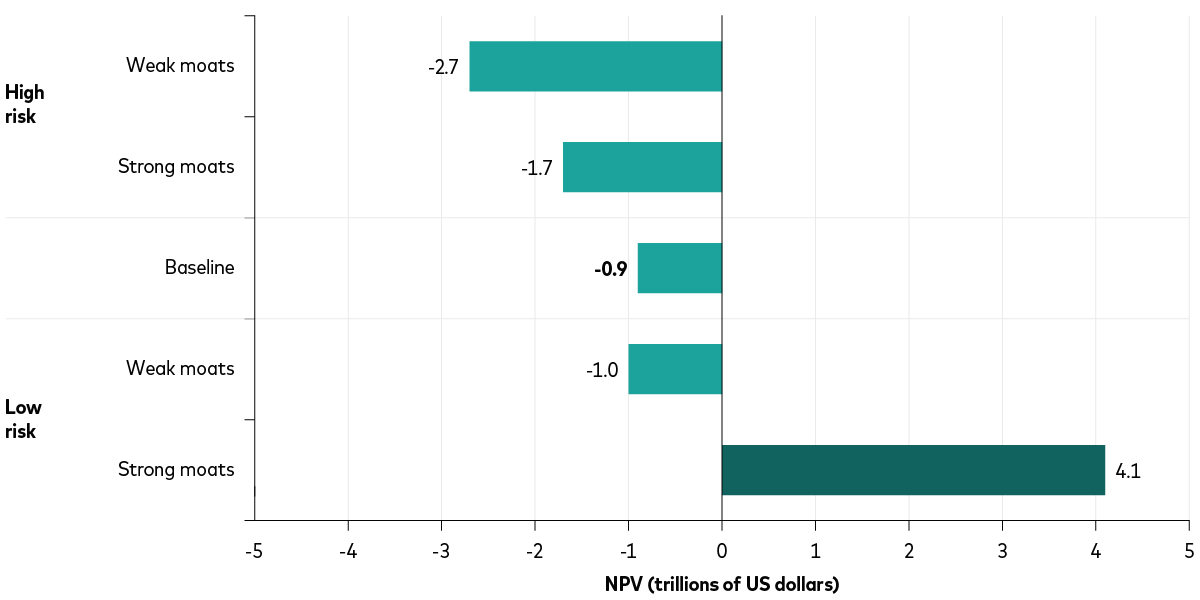
Notes: This chart aims to estimate the net NPV of AI-related investment. It assumes investment, including R&D spending and capital expenditure, by AI and AI-related companies of $3.1 trillion from 2025–2027. AI and AI-related companies include Amazon, Meta, Alphabet (Google), Tesla and other companies involved with semiconductors and semiconductor equipment, software, tech hardware and electrical utilities. Earnings before interest and taxes (EBIT) assumes revenue equal to the incremental real GDP in the megatrends “AI wins” relative to “deficits dominate” scenarios (Davis, 2025); a seven-year straight-line depreciation schedule for current and expected capital expenditure; and an earnings before interest, taxes, depreciation and amortisation margin of 37% (75th percentile of the S&P 500). We also assume that 40% of value creation is captured by shareholders. Expected EBIT over the next 25 years is discounted back at a baseline rate of 15%. “Strong moats” refer to business value capture of 70%, and “Weak moats” refer to business value capture of 20%. “Low risk” refers to a discount rate of 10%, and “High risk” refers to a discount rate of 25%.
Sources: Vanguard calculations, based on data from Bloomberg, as at 25 October 2025.
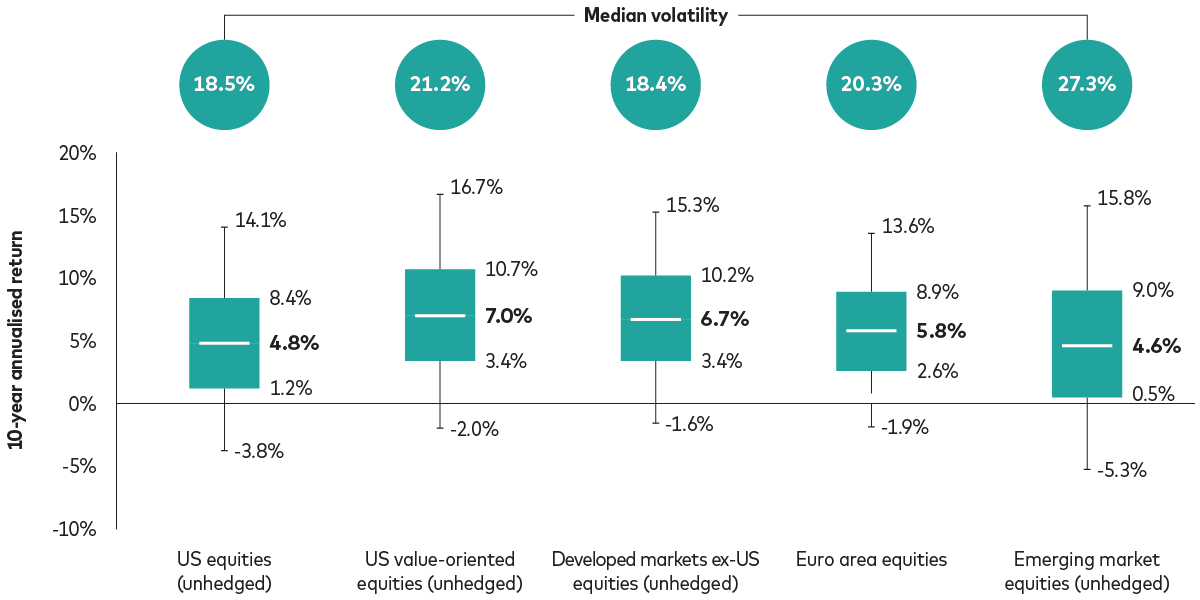
The above assessments inform our constructive outlook for non-AI scalers, and specifically for value-oriented US equities and developed markets outside the US. For both of these sub-asset classes, we project 10-year annualised returns of roughly 7%. These segments offer more reasonable valuations, healthy dividend yields and the prospect of realising efficiency gains.
At the same time, US value and developed ex-US equity markets could be better positioned if AI under-delivers on productivity gains, a scenario which would expose today’s high valuations in US growth stocks and parts of emerging markets.
10-year forecasts: Returns and volatility
Any projections should be regarded as hypothetical in nature and do not reflect or guarantee future results.
Notes: The forecast corresponds to the distribution of 10,000 VCMM simulations for 10-year annualised nominal returns in EUR for assets highlighted here. Asset-class returns do not take into account management fees and expenses, nor do they reflect the effect of taxes. Returns do reflect the reinvestment of income and capital gains. Indices are unmanaged; therefore, direct investment is not possible. Benchmarks used for asset classes: US equities – MSCI USA Total Return Index; US value-oriented equities – market-capitalisation weighted portfolio of stocks with a price/book ratio in the lowest one-third of the Russell 1000 Index; Developed markets ex-US equities – MSCI World ex USA Total Return Index; Euro area equities – MSCI European Economic and Monetary Union (EMU) Total Return Index; Emerging market equities – MSCI Emerging Markets Total Return Index.
Sources: Vanguard calculations, as at 31 October 2025.
IMPORTANT: The projections and other information generated by the VCMM regarding the likelihood of various investment outcomes are hypothetical in nature, do not reflect actual investment results and are not guarantees of future results. Distribution of return outcomes from the VCMM are derived from 10,000 simulations for each modelled asset class. Simulations are as at 31 October 2025. Results from the model may vary with each use and over time.
1 Source: Refinitiv, as at 31 December 2025. The MSCI All Country World Index returned 22.9% in 2025, in total return USD terms. In GBP terms, the MSCI All Country World Index returned 14.4%.
2 Source: Vanguard economic and market outlook, as at 10 December 2025.
3 The cyclically adjusted price-to-earnings (CAPE) ratio is a valuation metric that compares a market’s current price to its average inflation‑adjusted earnings over the past 10 years, helping investors assess whether equities are historically over‑ or undervalued.

IMPORTANT: The projections or other information generated by the Vanguard Capital Markets Model® regarding the likelihood of various investment outcomes are hypothetical in nature, do not reflect actual investment results, and are not guarantees of future results. VCMM results will vary with each use and over time. The VCMM projections are based on a statistical analysis of historical data. Future returns may behave differently from the historical patterns captured in the VCMM. More important, the VCMM may be underestimating extreme negative scenarios unobserved in the historical period on which the model estimation is based.
The Vanguard Capital Markets Model® is a proprietary financial simulation tool developed and maintained by Vanguard’s primary investment research and advice teams. The model forecasts distributions of future returns for a wide array of broad asset classes. Those asset classes include US and international equity markets, several maturities of the US Treasury and corporate fixed income markets, international fixed income markets, US money markets, commodities, and certain alternative investment strategies. The theoretical and empirical foundation for the Vanguard Capital Markets Model is that the returns of various asset classes reflect the compensation investors require for bearing different types of systematic risk (beta). At the core of the model are estimates of the dynamic statistical relationship between risk factors and asset returns, obtained from statistical analysis based on available monthly financial and economic data from as early as 1960. Using a system of estimated equations, the model then applies a Monte Carlo simulation method to project the estimated interrelationships among risk factors and asset classes as well as uncertainty and randomness over time. The model generates a large set of simulated outcomes for each asset class over several time horizons. Forecasts are obtained by computing measures of central tendency in these simulations. Results produced by the tool will vary with each use and over time.
The primary value of the VCMM is in its application to analysing potential client portfolios. VCMM asset-class forecasts—comprising distributions of expected returns, volatilities, and correlations—are key to the evaluation of potential downside risks, various risk–return trade-offs, and the diversification benefits of various asset classes. Although central tendencies are generated in any return distribution, Vanguard stresses that focusing on the full range of potential outcomes for the assets considered, such as the data presented in this paper, is the most effective way to use VCMM output.
The VCMM seeks to represent the uncertainty in the forecast by generating a wide range of potential outcomes. It is important to recognise that the VCMM does not impose “normality” on the return distributions, but rather is influenced by the so-called fat tails and skewness in the empirical distribution of modelled asset-class returns. Within the range of outcomes, individual experiences can be quite different, underscoring the varied nature of potential future paths. Indeed, this is a key reason why we approach asset-return outlooks in a distributional framework.
Investment risk information
The value of investments, and the income from them, may fall or rise and investors may get back less than they invested.
Past performance is not a reliable indicator of future results.
Any projections should be regarded as hypothetical in nature and do not reflect or guarantee future results.
Investment risk information
The value of investments, and the income from them, may fall or rise and investors may get back less than they invested.
Past performance is not a reliable indicator of future results.
Any projections should be regarded as hypothetical in nature and do not reflect or guarantee future results.
Important information
For professional investors only (as defined under the MiFID II Directive) investing for their own account (including management companies (fund of funds) and professional clients investing on behalf of their discretionary clients). Not to be distributed to the public.
The information contained herein is not to be regarded as an offer to buy or sell or the solicitation of any offer to buy or sell securities in any jurisdiction where such an offer or solicitation is against the law, or to anyone to whom it is unlawful to make such an offer or solicitation, or if the person making the offer or solicitation is not qualified to do so. The information does not constitute legal, tax, or investment advice. You must not, therefore, rely on it when making any investment decisions.
The information contained herein is for educational purposes only and is not a recommendation or solicitation to buy or sell investments.
Issued in EEA by Vanguard Group (Ireland) Limited which is regulated in Ireland by the Central Bank of Ireland.
© 2026 Vanguard Group (Ireland) Limited. All rights reserved.